Search This Blog

Showing posts with label Archeoseismology. Show all posts

May 13, 2015

Ah, Italia! Part Two: The Imprint of an Earthquake

Our first destination on our trip through Italy was Pescina.The main reason for our trip to participate in the Sixth INQUA Workshop on Active Tectonics, Paleoseismology, and Archeoseismology with the theme of Quaternary Geology and Paleoseismology in the Fucino and L'Aquila Basins.

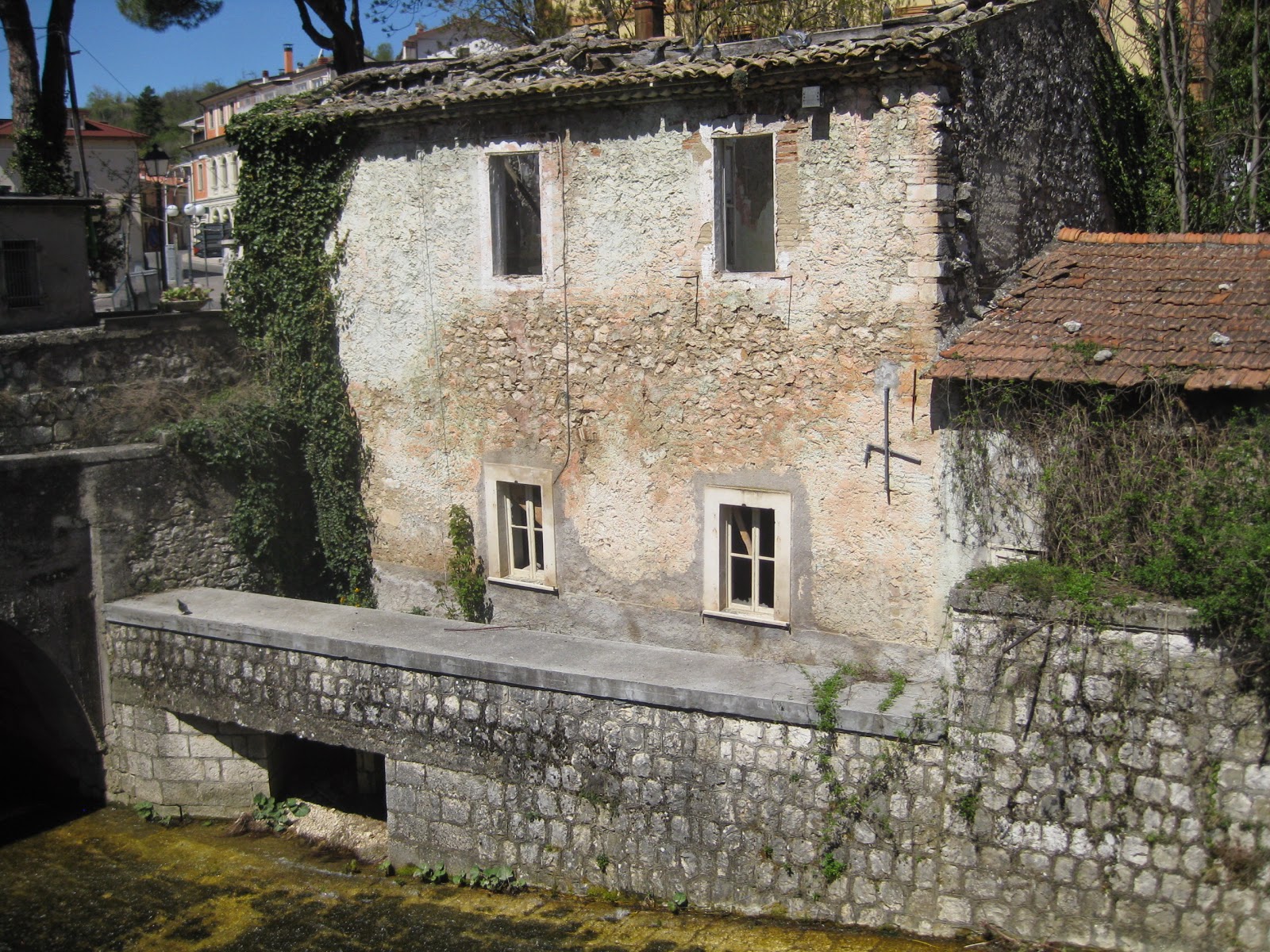
Both the Fucino and L'Aquila basins are the source of devastating earthquakes with faults running parallel along the length of both basins and in the bordering Abruzzo-Appenine mountain range. The meeting commemorating the 100th anniversary of the Avezzano earthquake was located in Pescina, one of several cities destroyed by the 1915 earthquake (est. magnitude of between 6.8 and 7.0). The town still has not completely recovered.

abandoned dwellings in Pescina

 
As well as extensive loss of life (estimated at 30,000 casualties), much cultural tradition and diversity disappeared in the wake of the catastrophe (Galadini, personal communication).

We were privileged to be shown one of the faults close-up and personal in a trench dug specifically for the field trip which culminated the workshop.

As a geophysicist used to working mainly with remotely sensed earthquake data (seismograms) and that of other geophysical phenomena, I am usually not able to 'see' the faults well in one of these (paleoseismic) trenches. Even when a patient and knowledgeable paleoseismologist points them out to me. In this case, the clear visibility of the fault structure (accompanied by lucid explanations from Paolo Galli and Fabrizio Galadini) was astounding and obvious, even to me.

Slip on a part of the San Benedetto dei Marsi fault, amazingly clear in this trench

One of the really interesting things about the Fucino basin is that it is a drained basin. It used to be called Lake Fucino and was partially drained by the Romans (a few ruins of the drainage efforts still exist) and then again completely, in the 19th century, by an Italian prince (Torlonia) whose engineer managed the task in a mere thirteen years. The basin today is one of Italy's most fertile regions.  Off the cuff estimate by Fabrizio Galadini: without constantly maintaining the drainage, the lake would refill in about twenty years.

Panoramic view of the Fucino Basin

The interesting and intensive field trip across both basins included a visit to L'Aquila, the site of the disastrous 2009, MW 6.3 (for publications: start here, for example and here) earthquake which occurred in the early morning hours on April 6, trapping many people in their beds. The earthquake will likely continue to remain notorious not only because of the tragic loss of life but also for the legal dilemma from the botched communications that ensued just prior to the earthquake.

Stitched photo of L'Aquila Basin from above

 Unfortunately, due to time constraints, we had to leave early and could not participate in the L'Aquila tour. But we made two quick side trips before making our way to Perugia, the next stop on our trip. The towns of Paganica and Onna received extensive damage from the 2009 L'Aquila earthquake. The parts of Paganica hardest hit are still in an abandoned state. Onna is a ghost town. Some visual reminders of the calamitous remains of the towns via pictures will be presented in the next post.

Photos: Klaus-G. Hinzen

Aug 26, 2013

More Pictures from Israel - the German-Israel Foundation Project

Since I'm smack dab in the middle of publishing Double Couple, book 3 of the Schattenreich series (more in the next couple of weeks - and especially the cover!), I don't have much to chat about right now, but wanted to at least add something of interest.

In addition to our work in Greece, the Bensberg Earthquake Observatory of the University of Cologne has also received a generous grant from the German-Israel Foundation for the research we are conducting in cooperation with Shmulik Marco, Professor of Geology at Tel Aviv University, to support our archaeoseismology work in Israel.

The scanner crew (Klaus-G. Hinzen and Gregor Schweppe together with Shmulik Marco and a couple of his students) spent two weeks in July scanning ruins in the north of the country. I hope to have a report from Gregor detailing their experiences (watch this space for it) and what it was like to stay at a kibbutz and, especially, where to get the best hummus in and around Tel Aviv.

As the crew was scanning Nimrod Fortress (or Nimrod Castle as it is sometimes referred to), a medieval stronghold guarding the important road to Damascus against the Crusaders (the ruins are located on the Golan Heights), they disturbed some of its current residents.

He looks interested but may just be annoyed. He certainly is adorable.

The inhabitants of this part of the castle were not amused at the intrusion and complained extensively.

These (and other) bat pictures inspired an important scene in my upcoming book (more on that later)!

Jul 7, 2013

Project HERACLES : Fieldwork Part 2: 3D Laser Scanning , Finishing Gravity, and the Lady Beekeeper

Our lean mean FARO scanner
3D Laser Scanning: what is it and what can you do with that? A 3D scanner basically takes 100,000 or more samples per second of an (at best stationary) object using laser range-finding, providing a point cloud that can render a highly accurate reconstruction (especially with the addition of a camera). Our new scanner from FARO is smaller-faster-better (and lighter - it can be taken as a carry-on, for example, on an airplane). These types of (active) scans are most useful for reconstructions and as an aid to modeling - the uses are varied, ranging from architectural planning to crime scene investigations (heavily alluded to in Primary Fault) to archeological site investigations (featured in Shaky Ground). Here, for example, one of our published scans from Roman ruins in the middle of Cologne.

I reported last time about our cleaning efforts prior to scanning - absolutely essential for getting a good scan. Luckily the east wall in Tiryns and the north wall in Midea (no direct links to either of the sites - but these links are very useful for background information) were cleaned for us by the crews at both sites for which we are tremendously grateful (thanks to Frau Dr. Demakopoulou, former archeological director at Midea and Frau Dr. Papadimitriou, Eforia of the Argolis, also participants in the HERACLES project, for their organizational help).
The brawny man on the right made the Tiryns east wall pretty for scanning.

 The scanning crew Klaus-G. Hinzen and Gregor Schweppe (also the passive seismic crew - geoscientists must be flexible, versatile and photogenic - WORD!) have made a plan of attack that includes the use of opaque white balls on broomsticks (geophysicists are also resourceful!) placed between the fallen rocks on the wall(s). The balls allow near-perfect alignment of the side-by-side scans. 

Balls on broomsticks amid a Bronze Age Cyclopean wall
 The new scanner needs all of 10 minutes to do a complete 360 degree color scan and even less for black and white. There is barely enough time between scans for the crew to enjoy the spectacular view from Midea. 
 
A momentary respite from the heat and wind to cool the scanner

Heat and wind - significant wind - conspire to slow down and even stop the measurements, especially when the scanner begins to overheat (at around 60 degrees Celsius). But the car air-conditioner serves as a quick cooler-downer (creativity!), the only casualty being Gregor's temporarily frozen hands.

Meanwile, the gravity crew, Evi Seferou and I, finished with traipsing around the Midea acropolis, concentrate on taking gravity measurements at the bottom of the hill - gaining profiles from different directions. After finishing the northernmost reach of our N-S profile, we start out on an E-W dirt road that looks promising because it seems less frequented by vehicles. 

Before we'd gone a scant kilometer, we encountered the end of the road and the beekeepers, a Greek giagiĆ” (and the last in the series) and her husband clad in thick white linen/cotton suits and wide-brimmed hats with face-protecting nets. Evi and I - standing just a few meters from the first of the bee boxes - are wearing black T-shirts. The bee man points at us (and the bees who are making passes at us) and tells us bees hate black. While we hurriedly take our last measurement, the man asks us if we are the ones who have come to count the bees. Instantly distracted (not that difficult, to be honest), I ask (through my translator Evi, of course), so how do you count bees? Turns out that you don't count the bees, you count the boxes - and there are approximately 10,000 bees in a box.


The Greek bee lady and a few of her bees
We adjourn just after and follow the beekeepers to their house in the village of Midea to purchase some of the honey. Because it is a Greek grandmother we are commanded to drink Fanta (you are much too thin! Drink! Drink!) and taste the honey (fabulous). 

The bee lady proceeds to show us pictures of her children (and grandchildren) and asks me questions in Greek, first in a very slow cadence and then louder and more insistent - the international solution to speaking to someone in a language they don't comprehend. Evi is trying not to pee her pants in laughter, especially as she's yelling back answers to the questions - repeatedly - while I try to smile nicely and look like I know what the hell is going on (all of the rapid conversation is not being translated to me - for which I'm grateful, I think). "Is she married!? Does she have any children!?" "Yes!" "She has a son!" And the Greek grandfather meanwhile is mumbling epithets ranging from the mismanagement by the government of everything to the end of civilization as we know it. After we pay for the honey and leave, I realize this is one of those moments that will live with me forever. And if I can't find a way to fit that into a story some way somehow, then I'm not much of a writer, am I?

The guards at Midea


The guards at Tiryns
A few days later, and it's already time to leave. We bid farewell to the environs, to the heat, to the culture, and to the helpful guards at both Midea and Tiryns


A free Greek spirit out for a stroll on Midea

A Helen of Troy contest? We never found out.


Fredocino: the only antidote to the searing Greek heat


Jun 24, 2013

Project Heracles: The Field Work, Part I


Field work, Day 1, was mostly spent unpacking the car, setting up and organizing the field office, establishing the survey base, and disassembling the first batch of seismic stations that had been recording since last September. Then it was off to the supermarket for basic supplies such as 2 liter bottles of water, sandwich making material, tomatoes, cucumbers, retsina, and ouzo. The absolute basics.

Days 2 and 3 were mostly spent in that nasty form of field limbo that geophysicists are sent to when things don't work: waiting for permits, endless discussions about why things don't work, and making trips to get parts and odds and ends. But despite the threat of rain, we made our first passive seismic measurements in Midea. Hurrah!
 
Klaus, Gregor, Hector and Evi leveling seismometers in Midea
  
Evi measuring a GPS location on a rock in Tiryns (they're digging in the wrong place, Indie!)
 Another important accomplishment was checking the extent of our new differential GPS in preparation for measuring a gravity profile extending all the way from Tiryns to Midea. Measuring gravity requires precise locations, especially elevation, because gravitational anomalies – those are the interesting things – can only be well modeled if the single points that are measured with a gravimeter are well known. The tidal corrections, elevation corrections, geoid corrections, etc. and so on, all depend on the accuracy of the locations. We are using a Scintrex CG-5 gravimeter that our Belgian colleagues Michel von Camp and Thierry Camelbeeck at the Royal Observatory in Brussels haven generously lent us for the experiments.

While doing our base station tests, we stopped near the house where we had installed a seismometer last year. The nice Greek grandmother who owns the house saw us and made us come inside where she plied us with cucumbers (from her garden), melons (from the neighbor's garden) and fresh well water. I wouldn't have understood a word of her non-stop exuberant conversation if it hadn't been for our versatile and multi-talented geophysicist helper Evi Seferou. Evi kept up a simultaneous translation of Grandma's speech which alternated between exhortations (Eat! Eat! You are all too thin!) and stories about her children, her garden, and whether we wanted to stay the night and keep her company. We brought her cookies the next day, and she yelled even more loudly over the fence and gave us more cucumbers to take home.
 
A very nice Greek grandmother. Part of me wanted to take her home with us.
 Day 4 was also mostly spent in discussions – it seems that the Greeks are very keen on this. Then after all the tiniest details had been covered, we began to clear the East Gallery in Tiryns in preparation for the 3D laser scanning. It was rank under-gardener work with an industrial weed cutter and hand-pulling dried grasses and the occasional Spritzgurke. Science at its least glamorous. These are the pictures they don't show you in the BBC or Nova presentations about how science works.

Under-gardening on a Mycenaean ruin

Friends for life - Gregor and an industrial-strength weedeater.
 Saturday, we worked until late afternoon – first measuring the gravity along the windy road leading up the slope to the acropolis of Midea. We were only seriously interrupted once by a goat-herding Greek grandmother (the second grandmother in a series of four). She wanted us to move the car because the goats wouldn't go past it. Superstitious goats? Not fond of French cars (Citroen)? She screamed at us (and not the goats) but did not offer us either cucumbers or melons. Her daughter came with a stick and length of thick rubber hose to encourage the goats to follow her. The hose made a low frequency noise as she dragged it behind her that enticed the goats. 

Goat and grandmother
 Evi told me that all the small landholders here have goats or sheep, a few olive or orange trees and impressive gardens (for cucumbers and melons). The government pays a small amount per annum to promote the continuance of the local farming economy. It's not enough to live on. Most of the farmers produce enough for their own use but not much more. 

The road goes ever on and on - the windy drive leading to ancient Midea, for example
Just call me the human raisin because that's what I'll be after another week in the Greek countryside with average temperatures around midday of 34o C in the shade. The east European heat wave is holding strong (probably at least until September), and is now accompanied by a hot wind. This is the perfect weather for a sweaty day in the field. It's the beginning of our second week.
 
 We completed the planned gravity profile between Tiryns and Midea (40 points total) and three passive seismic arrays. It was not easy. Another screaming Greek grandmother – the Greek name for them is giagiĆ” (pronounced yaya – with emphasis on the second syllable) – threatened the passive seismic crew (Klaus-G. Hinzen and Gregor Schweppe) until Evi calmed her down and convinced her we were not out to steal her land or the hidden gold. Greek men on mopeds were asking what we – Evi and I, the gravity crew – were doing on their land. Our story was convincing enough: that we are investigating the substructure, searching for local faults. One cute Greek guy asked if we were looking for gold. Apparently everyone believes there are hordes of gold secreted all over Greece. Nearly everyone has a map from someone's grandfather with an 'x marks the spot'. Myself, I would just be happy with a hidden grotto with cool spring water and some shade trees.
Hot but not bothered

Next up, Laser scanning, wildlife, and more! Greek grandmothers.

Jun 16, 2013

Project Heracles: On the Road

will clean windows for pizza
I had always suspected there were fairies (die Feen) in Germany, but I didn't expect to meet one at an Autobahn rest stop on the drive from Cologne to Tiryns, Greece for this year's geophysical measurements. This charming Fee was short on cash and wanted to wash our windshield for lunch money.

After a short piece of road and an even shorter piece of Austria, we crossed the Brenner Pass into Italy. The sun shone as we descended to the Po Valley. I tried to calculate how many of the vineyards we passed were there only to support my annual wine intake, but thought better of it.

approaching the Brenner Pass
Early evening, we arrived in Forli, a sleepy university town just south of Bologna, where we had a scrumptious dinner at a cozy Trattoria. I had homemade ravioli in a cream sauce with green asparagus accompanied by a crisp white wine (only a small portion of vineyard) and one too many Limoncellos.

Our ferry trip next morning from Ancona to Patras proceeded with nary a problem. Rain clouds chased us from the harbor but then gave up and hugged the coastline.We sat on deck all afternoon and again the next day until we docked. The frolicking dolphins showed up during the few minutes I went back to the cabin to freshen up (and disappeared before I returned). I finished reading Ready Player One by Ernest Cline, our Worlds of Wonder Book Club selection for June. I also read Double Double, a memoir cowritten by one of my favorite mystery authors, Martha Grimes with her son Ken.

 After debarking in Patras, the drive to Tiryns was by turns laborious and grueling due to the perpetual (and seemingly perpetually halted) road construction for most of the way.

Anthemion Guest House, our regular 'field hotel' located on the outskirts of Napflion was there to welcome us, along with its friendly and accommodating proprietor, Sofia. It felt like a home away from home. We met the students for dinner (at Scuola in Napflion) and anticipated the first day of field work.


Jun 5, 2013

HERACLES: Archeoseismology in Tiryns, Greece, Year 2


T-3 days and counting to take-off. Okay, geophysical field work is not as exciting as going into space, granted, but for a solid earth geophysicist, the earth's surface - and near surface - is not only The Final Frontier, it's the only frontier. Planetary, oceanic and atmospheric geophysicists - your frontier (and mileage) may vary.

The pile of things we have to load into our departmental VW Caddy is growing by the minute. Literally. Saturday we will hit the road, driving first from Bensberg, Germany to Ancona, Italy (it's where the calf bulges out on Italy's boot). Getting on the car ferry. Then after debarking from Patras, Greece, driving the rest of the way to Tiryns where we hope to arrive on Sunday evening (and immediately descend on Scuola, our favorite Italian restaurant - even if it is in Greece, they have the best Caesar salad I've ever had in Europe).

Last year we had a monster Mercedes van from the Sonderforschungsbereich 'Our Way to Europe' of the Uni Cologne. It even had the motto, 'Our Way to Europe' painted on the side. Given the shaky nature of European relations at the time, we covered it up with our magnetic, Erdbebenstation Bensberg sign, hoping that wouldn't incite the Greek natives to come at us with pitchforks and torches quite as much. This year we're leaner and meaner since we're not taking the seismic refraction equipment with us. The passive seismic stations are still in Greece from last year where they've been recording local events for the past nine months, powered by battery and solar panels.

Our work this year will mainly be concentrated in Midea (we hope - we still haven't gotten the permission to work there - ah, Greek bureaucracy!), another fortified palace ruin on its own hill about 7 km northeast of Tiryns. (updated: we got the permission today - T-2 days. Do they read blogs there?)

The excitement (and the terror) of this year's field work is that we have purchased a differential GPS instrument that we'll be using for the first time in Tiryns/Midea and we'll be 'test driving' our new (also leaner and meaner) 3D laser scanner. Most field geophysicists are uniquely suited to these kind of experiments that I call, 'let's take a bunch of new equipment we've never tested before and go out in the field.' That's not because we're so smart, it's because we're flexible. We have to be. When you have cables and electronic devices and sensitive instruments, combined with weather extremes, precipitation and the unknown variables that always come into play during a measurement, something always goes wrong.

But it pays to be philosophical (translate: stock up on ouzo and Retsina and Mythos).


This is a big reason to look forward to the end of the working day at Tiryns.
 Our measurement plans this year include gravity measurements - this time with an ambitious plan to extend a profile from Tiryns to Midea - passive seismic (H/V), Transient electromagnetics (with a Greek colleague), and the laser scanning.

Dida from Tiryns
KƤse from Anthemion House

Barbara from Midea
Our Greek colleagues from the animal world will be waiting for us as well. (Note to self: don't forget the dog and cat treats).


I'll be posting on our progress (with pictures) on the journey to Tiryns (it will be my first time to cross the Italian Alps) and, time permitting, on the measurements.

Nov 28, 2012

The Next Big Thing


I was tagged for this post by Priya Sharma for which I'm grateful. It's a cool thing. Stop now and go immediately to Priya's site and read her interview about a story that she's very promptly sold! While waiting for her story to appear, you can read some of her other fine stories at Albedo One, Black Static (issue 28) and Interzone (current issue).

Next week, plus or minus a few time zones, Richard Jones (blogging here) speculative fiction writer and author of A Dude's Guide to Babies (pre-order now!) will be posting his answers to these questions.


1) What is the working title of your next book/short story/project?

My next published book will be Shaky Ground, due out in a few weeks. My next (still-in-my-head) book will be an alternate-historical mystery with the working title of Tainted Earth. The two don't have anything in common despite the titles and the German setting.

2) Where did the idea come from for the book?

This is a complicated and not completely linear thing, this genesis of ideas. I suspect it's probably that way with most writers. Anyway, I'll try.

Shaky Ground is the sequel to Primary Fault, the first book in my Schattenreich series. I got the idea for the first book when we first started working on the archeoseismology of the Roman ruins being excavated in the Archeological Zone in Cologne (the paper that came out of that project is open access, published by Springer Verlag and downloadable here). The events in the novel are all fictional, but the real world controversy surrounding the (still unsupported) hypothesis that an earthquake could have forced Charlemagne, Emperor of the Holy Roman Empire, to abandon his seat of government in Cologne for Aachen greatly inspired me. Even though the Schattenreich series is contemporary, I also have plans to do a few historical shorts linking the past and the present.

But what really caught my fancy was a certain Roman well – a part of the excavations in the middle of Cologne – just across from the Rathaus or City Hall, in fact. This Roman well, still in use in Charlemagne's time, kept bugging me, wouldn't let me go. Plus I had started reading heavily about Druids and continental Celts and knew that had to be a part of the story. Druids+Roman ruins+Earthquakes. It was enough to get started. Even though the Roman well doesn't come into play until Shaky Ground, it was always there, in the back of my mind while writing the first book.

So, complicated.

3) What genre does your book fall under?

Fantasy suspense with a healthy dose of romance.

4) What actors would you choose to play the part of your characters in a movie rendition?

Ha! I love this question because actually answering it will totally ruin everyone's – including my own – private images of the characters in the book. After giving it much thought, there's only two characters I'd pin down with an actor/actress: Anne Hathaway would, I think, be the perfect Caitlin Schwarzbach. Marco Girnth, a German actor who is mainly known for his work in the television police procedural SOKO Leipzig (the show is not particularly riveting, but I do enjoy watching Marco Girnth :-)) would be the perfect Heinrich von der Lahn and matches the mental picture I have of him.

I'm still trying to figure out who could play Sebastian von der Lahn. He's the most complicated character in the series, and I have to admit, I'm completely stumped. There are probably a half dozen excellent German actors who could do the role justice. Specifying an actor to play Hagen von der Lahn remains beyond my abilities at the moment. Gus Schwarzbach is such an amalgam of people I've known in my life, that it would also be impossible for me to pin him down. From looks alone, though, Garth Brooks comes pretty darn close.

5) What is the one-sentence synopsis of your book?

A tale of seismology, Druids, and an evil blonde.

6) Will your book be self-published or represented by an agency?

Self-published under my imprint, Terrae Motus Books.

7) How long did it take you to write the first draft of the manuscript?

Four months. But it's taken me over three years to get it into publishable shape. It was a complete mess. It was the second novel (after Primary Fault) that I wrote. Even though I'm an incurable Pantser, Shaky Ground was the last novel I will ever write without some sort of a Road Map. I realized after it was finished that I didn't ever want to wander in the wilderness like that again.

8) What other books would you compare this story to within your genre?

Difficult, since it's a mix of real world science and contemporary fantasy. There's Outlander, by Diana Gabaldon, but other than the Celtic cultural references and the romance aspects, the two books couldn't be more different. I would love to have it compared to Roger Zelazny's Amber series, but the comparison falls short once you get past the Otherworld/mythological aspects and the freaky Gothic castle.

9) Who or what inspired you to write this book?

That's easy. Impending unemployment (that thankfully did not transpire!) Plus encouragement from another scientist who had written a novel (and gotten it published). I thought, if he could do it…so I sat down one day and started with Chapter 1. No plan. No real clue at all. Three months later I had Primary Fault. That was a little over five years ago. And after I finished, I immediately started writing the sequel, Shaky Ground. Everyone warned me away from doing that, from continuing to write books in a series before I had sold the first one. They were completely right. But I'm incredibly stubborn. And not so smart. However, I am immensely glad I did it. It's been a liberating experience, writing the books I always wanted to read. I'm now writing the fifth and final book in the series (if I change my mind on this, please just push me off a cliff). 


Oct 24, 2012

Notes from the field: Tiryns, 2012

At the beginning of our last day in the field, the sun was already well above the ruins of the Mycenaen castle in Tiryns. We had to wait for the GPS to wake up - he'd been increasingly sluggish the last week. Then we made some random gravity measurements and a few quick profiles before the van had to be packed for the drive back to Germany (on the Superfast ferry from Patras to Ancona, Italy and then overland). Most of us flew back to Cologne from Athens.

Looking back, three days later and home in rainy Cologne, it's amazing all the data we collected: passive seismic, P-wave tomography, S-wave tomography, active seismic (in place until next spring), gravity, and differential GPS locations for almost everything. Hector, our doctoral student also did some structural geology measurements.

It's been a field campaign of varying length. A couple of us had been there for four weeks at that time, others three weeks. I think I could have handled another week, but then would have come to the end of my endurance. Once you're over fifty, you really feel it in your bones when you're measuring in 35oC for eight hours a day. I wouldn't have been able to stand it if it weren't for my lovely and capable measuring partner, Jana (featured below).

 A girl and her differential GPS. It's not easy looking good in the field, but Jana managed it every day.
Next year we'll go back to uncover Medea's geophysical secrets.

A pictorial journal shows the highlights of our Odyssey along our appropriately-named project HERACLES.


The van with its Uni Cologne logo - driven from Cologne to Tiryns and back again.
A panoramic view of Tiryns castle from the east

West view of the castle from the aptly named Mosquito Alley. A mini seismometer array lurks in the foreground
 
Science in Action! Here's the newly designed shear wave source being applied to a refraction line on Mosquito Alley.

Our hotel pool at Anthemion House and a view to Napflion and the hills beyond. Unfortunately, we could not enjoy the pool as much as we would have liked due to just being too darn tired at the end of the day.

Dida, the dig Hund helping Gregor analyze the day's data.