Search This Blog

Showing posts with label Celtic mythology. Show all posts

Mar 7, 2016

The Schattenreich Mythology: Ankou

Hagen nudged my knee with his. “Do you know who Ankou really is?”

“Why don’t you just come on out and tell us?” I asked.

“Many think that Cernunnos is equated with Dis Pater, who Caesar claimed was the chief of all the Celtic gods. The Big Guy, so to speak. His original Celtic name is lost. Or, more likely, hidden. Others think it is Taranis, sometimes Lugh, but not often. Taranis and Lugh are solar, possibly the same being with different names. Dis Pater is definitely a dark, underworldy god.”

“You think Ankou personifies Dis Pater?” Heinrich joined me in admiring the river, slipping his sunglasses on. “Wow. I’d never really thought about him like that, but…there’s nothing to dispute it. I think of Cernunnos as Lord of the Underworld and Ankou as—”

“Subservient, I think, is the word you’re looking for. He assumes the role, at least in the times I’ve seen them together,” Hagen said, repositioning his cutlery and obviously suppressing some excitement.

“And if he is Boss Celt—” I began.

Hagen laughed and glanced around. “Not only that. Boss German, too.”

“Wōden? Ankou incarnates Wōden? What makes you think that?” Heinrich asked.

“He has all of Wōden’s attributes. The cape, the spear – it’s a staff with a curved iron blade in Ankou’s case. The hat, but he doesn’t wear it all the time. He rides a kaveg.”

“He leads the Wild Hunt,” Heinrich said. “At least he led it on Kala-Hañv.”

“He controls the wind – is that also Wōden?” I asked.

They nodded.

“He herds the dead,” Hagen said.

“With your help. But Ankou has two eyes,” Heinrich said. “Wōden lost an eye if I recall.”

“The eye is symbolic. Ankou is not all-seeing. He’s lost the ability. It has something to do with the closing of the veil. I can’t tell you why, but I’m sure of it.”

“What does all that have to do with Caitie?”

“I’m not at liberty to say,” Hagen said.

“Your geis,” I said.

Heinrich frowned. “Wōden got around.”

“He’s a fertility god. Same as Cernunnos.” Hagen shrugged. “There’s so many things that make sense all of a sudden. But I don’t know how to use it to help us yet.”

This excerpt from Book 4 of The Schattenreich, Shadow Zone, refers to a Celtic father god, named by Caesar as Dis Pater. This is a pretty good (if not complete) summary of my interpretation of the Germano-Celtic Lord of the Dead. Ankou aka Woden aka (according to Caesar) Dis Pater. Caesar even claimed that the Gauls believed they were descended from this 'unnamed' deity. According to some scholars (e.g., Derek Bryce in his introduction to his English translation of some of Anatole Le Braz's collected folk tales), the Breton people, although traditionally Catholic, were particularly resistant to suppression of some of their pagan traditions. These traditions also included acceptance of the existence of mythological (and superstitious) events.

 Anatole Le Braz collected these 'folk' tales in the late nineteenth century. The above named collection, Celtic Legends of the Beyond, also include some references to Ankou in the form of 'recollections' of his visits and one in particular that I also freely borrowed from (Hell) in Book 5 of The Schattenreich, Triple Junction in the form of an oral tale told by Bertha von der Lahn.

So who is Ankou?

Ankou is a Breton (Celtic) psychopomp, tales of his exploits handed down in the folk tales of Brittany. The (probably) much more ancient figure (or deity) he represents has been lost to history. Since he's specific to Brittany, there's scant mention of him - neither from Miranda Green (The Gods of the Celts) nor from Marie-Louise Sjoestedt (Celtic Gods and Heroes).A couple of paragraphs at least  were devoted to him in Celtic Culture, A Historical Encyclopedia, edited by John C. Koch.

Characteristically, he wears a wide-brimmed hat, a cape, has long white hair, might or might not have a scythe, and drives a wagon (or even a train) that he uses to collect the dead. Koch cites references of a similar figure that date to 16th century Breton.

He's been interpreted by such  modern authors as Elizabeth Hand in her fantasy series Winterlong (as Book 1 of the series is also named) as a white dog and by Neil Gaiman in his Sandman series as a powerful immortal being in the form of a young Goth lady.

I've painted a broader and more syncretic interepretation of Ankou, binding him with the Germanic god Woden (=Wotan=Wodan=the Nordic father god Odin) in the tradition of finding parallels between Celtic and Nordic/Germanic religions such as those discussed by H. R. Ellis Davidson in her fabulous book, Myths and Symbols of Pagan Europe. The two figures, Ankou and Odin/Woden have much in common: passage of the dead, ruler of the afterlife, broad hat, white hair. Odin rode Slepnir, Ankou drove a wagon. Okay. But about Odin much much much more is written (see, for example, A Dictionary of Northern Mythology, Rudolf Simek).

About Ankou, practically nothing.

This gives me a lot of Spielraum for interpretation and free-association. I made full use of this - equating Ankou/Woden to an even more ancient figure who possibly was the progenitor, the Dis Pater that Caesar spoke of, to the continental Celts. God of death, fertility, poetry, a seer, In other words, a god with many faces, some more beautiful than others.

photo credit:

ankou de La Martyre via photopin (license)


Jan 10, 2016

New Year, New Bargain at Terrae Motus Books


Excerpt from Shaky Ground


"Susanna's really pretty. And poised. She's just so perfect. In every way."

"That's Mary Poppins, Caitie. Besides, who wants perfect?"

"Well. They would have made an ideal couple."

"The only one who thinks that is her mother," Samantha said. "If Hagen wanted Barbie, he could have had any number of them by now."

I remembered Sebastian's words about my not being Hagen's most beautiful lover. "So you think he prefers Midge." I felt glum as I stuffed the last piece of toast in my mouth.

She laughed. "If anyone is Midge, it's me. My mom has an original from the sixties. She looks exactly like me, including freckles."

"Well, I'd rather be Midge any day. She's perky at least. Barbie looks like she's just gotten home from her lobotomy."

"Who needs brains when you've got shoes to go with every outfit?" She giggled, snorting.

"And if you lack a frontal lobe, you really do need to have color coordinated clothes." I dribbled red wine on my shirt.

We both cracked up. It felt good to laugh hard and it felt nice being there with Samantha. I hadn't realized how much I missed her company. She refilled our wine glasses and we moved to the couch.

"Have you heard from Hagen lately?"

I just shook my head, wishing we could get off the subject of Hagen. For a minute, I had imagined I was enjoying myself.

"It's just so strange. First he gives you this beautiful pendant, and then a car, for God's sake, and goes poof into the night."

I sighed. "It was morning when he left."

"What do you mean morning?"

"We spent the night together and he left in the morning before I woke up," I said.

"Without even a goodbye kiss?"

"My but we're nosy today."

"Well, you would have given him a goodbye kiss if you were going away for a couple of months, wouldn't you?"

I would never have gone in the first place. "Well, since you asked, we had plenty of those in the hours before he left," I said. And a farewell message, a message that haunted me each night. Words came into my head.

          Night is longing without you.
          The dawn breaks cold.
          With no promise of your touch, a barren land. 


awarded an Indy B.R.A.G. medallion, 2014

On sale now through February 1, 2016 for 0.99 cents (or equivalent - due to VAT and conversion, prices may vary slightly) at:

Amazon worldwide 
iBooks
Kobo
Nook
the Tolino group (Hugendubel, Thalia, Weltbild and Mayersche)
All Romance Ebooks

Additional outlets


Shaky Ground cover illustration by Yaroslav Gerzhedovich

Steffi Love shoes on old Barbie feet via photopin (license)

Dec 21, 2015

The Schattenreich: Heinrich's Songs (2)

Wishing everyone a safe and peaceful holiday season.   


Love Never Gives Up
Heinrich von der Lahn


If Death takes us down, take it again.
You have to believe in the power
When you have no better way.
When destiny strikes the hour,
The gods will have their say.


And Death takes us down.
The shape of things to come
Is hidden from us all.
While the promise of dark wisdom,
Keeps you in its thrall.


Refrain
Hold the one who matters near.
Let her drink from your cup.
Through your sorrow and your fear,
Love never gives up.

Death marks us all.
It’s his duty and his right.
Yet we must walk his road
Without an end in sight.
The past weighs our load.


Though Death marks us all,
That is not where it ends.
Life’s load makes us sway
With its twists and bends.
But Love’s light shows the way.


Refrain
Hold the one who matters near.
She will share your poison cup.
Through your sorrow and your fear,
Love never gives up.

Hold the one who matters near.
Musn’t be easy to be good.
We will find our way back to each other.
Never fear Ankou’s wood.
The years may pass, but our love never will because
Love never gives up.


photo credits:

my wooden heart via photopin (license)

 Fisheye Snowscape via photopin (license)

Brittany Tree, Klaus-G. Hinzen, 2013

Feb 16, 2015

An Interview with me from A. L. Butcher

Alexandra Butcher has graciously agreed to interview me and her questions were very thought-provoking.

The interview takes place on Alexandra's blog, The Library of Erana

I suggest (very loudly but nicely) that you check out her books. From her website:

The Light Beyond the Storm Chronicles
A series of adult dark fantasy romance adventures set in the world of Erana, a dark world where magic is forbidden and elves live as slaves beneath the iron grip of the ruling and corrupt Order of Witch-Hunters. Yet despite their best efforts magic still exists, all be it hidden, suppressed or denied.  In book one in this dark world a young elven mage flees for her life, pursued by her former owner, slavers and the Order and encounters a mysterious and powerful man. Together they seek to save an elven child stolen from her home, to avenge the wrongs done and to find some light in the darkness. Secrets, lies, revenge, romance, sex and sorcery fill this adventure.


More information here with references to reviews, progress on the series, and most importantly, links to where you can buy the books. I'm looking forward to reading them.

In addition, Alexandra's widespread interests have resulted in several short stories and an impressive number of interviews with an interesting mix of creative types. Just breeze though the list of her accomplishments in 2014 here to figure out where you want to go next!

My thanks to Alexandra and continued success with writing and learning journey!


Nov 24, 2014

Schattenreich Mythology: Warrior Goddesses, Dark Queens, and Black Friday specials

Her name is Cathubodua (possibly pronounced cahú-bodwa or catú-bodwa) and what we know about her is limited to one main inscription (with the 'C' missing) from France. The name according to several sources, has been interpreted to mean 'battle crow'.

That's not much, is it?

But there is correspondence to the other more widespread fertility and warrior goddesses such as Badb or Bodb, Nemain, and the Morrígan (also known as the Demon Queen or Dark Queen). What these fearsome ladies have in common is their love of battle and death, their fertility powers, their temper, and their ability to transcend age and outward appearance, and their shapeshifting abilities.

In the Schattenreich series, I have incorporated many of these qualities into the Breton-Gaulish deity called Cathubodua. She commands a cohort of the Folk (the Tud) who can shapeshift into frightening and dangerous forms of crows/ravens (there are no real animals in Ande-dubnos).

What makes her special is her relevance. Despite her totally Celtic origin - there is no real equivalence in the Germanic or even the Greco-Roman pantheon - she continues to thrive. I've chosen this actuality in spite of the softening of female deities since the Iron Age through persistent and detrimental whittling down by Christian (and New Age pagan) influence.

Goddesses with a darker bent just cannot be beaten down. The reasons for my choice have to do with how society has evolved to totally negate and, to a certain extent, bury the ancient reverence for powerful female symbols of both war and fertility. The need for such symbols exists, even today, perhaps much more than ever. But that's just my opinion. Take it or leave it.

Cathubodua serves as both adversary and teacher to heroes (and heroines, as the case may be). A telling line from her conversation with Catilin von der Lahn in Shadow Zone, Book 4 of the Schattenreich series explains the dichotomy

"Can I ask you something else?” I made my voice soft. When I returned to my life, my enemies would be waiting for me along with the people I loved.

She gazed at me, and the motherly crone appeared. “You may.”

“Why do you pit Dagmar against me?”

“She makes her own choices.”

“And if I defeat her? Will that make you my enemy?”

“I have no interest in your squabbles in the waking world as I have little influence there. Unfortunate, that is. You are of the blood. Only those who choose to be my enemy are.”

And that sums up Cathubodua's philosophy quite well. She wants to walk among us again...and waits for her chance. As so many of the Ande-dubnos dwellers.

Book 2 of the Schattenreich
Book, 1 of the Schattenreich
And now, Black Friday. All this week and through the weekend, Primary Fault and Shaky Ground are discounted to $0.99 at many retail outlets. 


References and recommended further reading:

Myths and Symbols in Pagan Europe, H. R. Ellis Davidson
The Gods of the Celts, Miranda Green
Celtic Culture, A historic encyclopedia, John, T. Koch
The Encyclopedia of Celtic Mythology and Folklore, Patricia Monaghan

photo credit: chrisotruro via photopin cc

Oct 7, 2014

BuchmesseCon: this Saturday, October 11, 2014


I will be here all day and giving a reading from selected passages from the Schattenreich series from 12:00-1:00 p.m. and signing and answering questions about world-building, writing series, Celtic mythology and, even, yes, earthquakes! A sneak preview of the fourth book, Shadow Zone, due out in a few weeks - well, it could happen.

 If you're anywhere near Frankfurt (the Con is in Dreieich - small suburb near the airport), please come by. There will be a wealth of German fantasy and SF authors presenting books, and it's going to be a full day.

Hope to see you there!

Mar 14, 2014

Interview from Richard E.D. Jones on Underground Book Reviews

The following interview was posted on the magazine Underground Book Reviews on February 26, 2014. I'm including it here, but encourage you to visit their site as there are many great interviews and indie book reviews. It's a classy site! Richard E.D. Jones also reviewed Primary Fault for the magazine. Not greatly into the cult of self, it was a fantastically fun interview and some of the answers might be of interest to readers of the Schattenreich series, so I wanted to repost it here.

Since Richard did me a great favor by reading my book, reviewing it and asking me a bunch of questions that were great fun to answer, I hope I can return the favor a smidgen by getting you to go check out his stuff.

A little bit about Richard:

Richard E.D. Jones is an award-winning writer and author of the hilarious how-to book for new dads, A Dude’s Guide to Babies: The New Dad’s Playbook. After surviving for a decade as a stay-at-home dad rearing three boys and a wife, Richard and his friend, Barry Robert Ozer, decided someone had to writer the user’s guide to babies for men. Broken down in to small chunks for easier, throne-sitting ingestion, the Guide has big print, a bunch of lists and a guaranteed laugh every 1.3 pages. Note, it’s not a money-back guarantee, ‘cause he’s not giving that back. 

In addition to working as a freelance non-fiction writer, Richard also writes a-bit-too-funny-for-their-own-good urban fantasy and science-fiction stories. Until Tomorrow, the story of the bastard son of the god of wine and revelry and himself the god of procrastination, still is looking for a home if you’d like to represent. 

His most recent finished novel is the genre-blending urban fantasy, Reptile Wisdom. The story takes place in the CurseWerks universe, the setting of several of his popular short stories. The novel deals with mad science, appalling magic, zombies, snot monsters and the occasional advisability of allowing a severed hand to roam freely throughout a mad scientist’s laboratory. Adventure, humor and redemption all wrapped up in one page-turning package. Representation rights available. 

Richard also is pounding the keyboard for his newest Work in Progress, a secret book that goes by the initials RL. It is a YA adventure book combining several of Richard’s favorite things. When he’s not lobbing softballs at more successful writers, Richard writes for the daily fatherhood blog, A Dude’s Guide to . . . Everything. His fiction can be found on Amazon.com and the website where he writes things ByRichardJones.

And now for the interview (the original on Underground Book Reviews is here):

Sharon Kae Reamer is a native Philadelphian, who coyly admits to being wowed by the original Star Trek series when it first aired on live television. She and her family quickly moved to slightly warmer climes in Texas, where she was raised in Dallas and attended Southern Methodist University, receiving an advanced degree in geophysics. While in graduate school, Reamer met a “sexy German guy” visiting the university and struck up a relationship that led to her moving to Germany and marrying her sexy guy almost twenty years ago. Currently, she works part time in Bensberg, Germany, as a research scientist and lecturer at the Earthquake Observatory of the University of Cologne. Reamer said she always planned to write speculative-fiction stories “someday,” but that day kept getting pushed further and further back. Eventually, she recognized that “someday” was today and started writing.

RICHARD E.D. JONES: Sharon, first off, please excuse the scientific fuzziness. I’m probably going to be lumping in things that would be egregiously wrong in your community, but work just fine for lay idiots such as myself. Still, I’ll try to not offend you too much. You’re an earthquake scientist. Caitlin is an earthquake scientist. You live in Germany. She lives in Germany. She gets dragged into a horrifying netherverse of mystical beings and danger. You get drag—Well, the analogy probably breaks down right about there. So how much of yourself did you put into Caitlin? And if, as I suspect, there might be a lot of you in the base DNA of your character, why?

SHARON KAE REAMER: It’s not easy for the non-specialist to tell the difference in specialties. Most people don’t even know there’s a difference between geologists and geophysicists. It’s similar to speculative fiction encompassing a whole range of subgenres including science fiction, fantasy, horror, etc.

But to clarify, I am not an earthquake scientist, I’m a seismologist. Under that name there are also a range of subspecialties, including earthquake seismology. For my dissertation, I studied the seismic effects of explosions so that makes me an explosion seismologist by training. My main character, Caitlin Schwarzbach, is a field geophysicist and data expert – give her some measurement data and she’ll give you results – since she worked as a consultant. She knows the basics of earthquake seismology, but her brother, Gus Schwarzbach, he’s the real earthquake expert.

As for similarities between Caitlin and myself, I gave her a scientist’s worldview and a Texas upbringing. This was important since much of the series is written in first person perspective from Caitie’s POV, and I had to be able to slip inside her head easily. I could relate to her on at least two critical levels, making it easier to start fleshing her out. But that’s where things start to diverge. She’s invested with many characteristics I’ve observed in strong Texas women, women I’ve known and admired. In many ways, I would love to be Caitie. I’d especially like to be as thin as she is. And she has a much better fashion sense than I ever did, even if she does have to model some of her wardrobe around those ropers. Her fear of Death is also something unique to her since she knows him personally. I don’t envy her that.


RICHARD E.D. JONES: One of the most fascinating things I found while reading Primary Fault is the way you fuse what seemed to be Celtic myth figures with Germanic aspects of magic. What made you consider this as the basis for your supernatural events in the novel? Was it difficult finding research materials?

SHARON KAE REAMER: I originally wanted the whole thing to be Germanic. But while researching the presence of the Germanic tribes in the Rhineland, I realized that, at least according to one scholar, some of the tribes were ‘Celticized’. So I twigged to the idea of mixing the two. I developed a deep backstory that moved things more firmly towards the Celtic end of the spectrum because I wanted to have Druids in there. The Germanic tribes didn’t have Druids.

With hindsight, I’m glad I did this because information on the continental Celtic pantheon is thin – the Celts didn’t write things down – and that allows more leeway in mythological worldbuilding. There are a ton of books on Celtic mythology, magickal practice, modern Paganism, the history of the Celts and speculation about whether the Druids even existed. But aside from the archeological evidence, there is little concrete knowledge about how the continental tribes lived and structured their society. Historians and archeologists basically have to sift through what the Celts’ conquerors, the Romans, particularly Julius Caesar, wrote about them.

The Germanic research material is more definite – historians have written evidence to work with – but it’s also been hard (for me in my research) to clearly separate the Nordic and (older) Germanic pantheons. Odin versus Wōden, for example. In addition, I’ve made a sincere effort to interpret where crossovers between the Celtic and Germanic mythology might be – it’s not a scholarly contribution but a fantasist’s conceit.

The reason I threw all the mythology in there instead of just a straight-up suspense/thriller was because I liked the ‘what if’ scenario of subjecting a person trained as a scientist to a substantial challenge to her worldview, namely, the existence of a supernatural Otherworld populated by Celtic deities.

I was somewhat leery of a purely Germanic thrust to the story because the series takes place in Germany, and I wanted to avoid steering the story into any areas that overlapped with Nazi mysticism or the like. It might seem like a cool idea, ‘hey, let’s throw some evil Nazis in there’, but after you’ve lived in Germany for any length of time, you don’t think there’s anything cool about Nazis, not even as stereotypical bad guys. There’s some backstory, particularly in the third book, that shines a light on the effects of the holocaust on the von der Lahn family. The characters also have to address their relationship to their Germanic heritage at some point. and I’m dealing with that right now while writing the fifth book.


RICHARD E.D. JONES: Let me state flat out that I’m not a big paranormal romance reader. Nothing against it, but I always found that either there was too much romance, not enough paranormal or, and this is my pet peeve, the authors turned vampires from vicious apex predators into superheroes with a tragic allergy to sunlight. Moving on. Your book has a lot of romantic tension in it, but I’m not sure I would classify it as paranormal romance. Most fantasy books might have a bit about will they kiss or won’t they, but they don’t have a lot of romance in it. Your book does. What made you consider the fusion of romance and urban fantasy? And thanks for not romanticizing vampires.

SHARON KAE REAMER: Funny you should mention vampires. There are parallels between the Celtic deities in the Schattenreich series and vampires. Both feed on human blood. But the Celtic power players go about acquiring it differently. They’re heavily invested in sacrifice.

I also never got into the whole paranormal romance thing either, although that doesn’t mean I won’t start reading the stuff someday. It does have an appeal and I’m sure there are many authors who do it well (Hell’s Belles by Jackie Kessler is on my hot hot hot reading list and A Modern Witch, by Deborah Geary is sitting in my Kindle). That said, reading (and being totally enthralled by) Outlander by Diana Gabaldon encouraged me to put in more rather than less sex as the Schattenreich series progresses because it’s definitely intrinsic to the series themes of sacrifice, surrender and redemption.

But I have a strong penchant for mythological fantasy with a healthy dose of magical realism. My ultimate Otherworld go-to has always been Roger Zelazny’s Amber series. It has influenced me heavily. But the love interest aspects in both his series left a lot to be desired, so to speak. I’ve read a fair amount of Simon Green’s Nightside series and Jim Butcher’s The Dresden Files and enjoyed them because they were different than the usual paranormal tropes. The badass chicks in both those series are sidekicks and strong characters in their own rights. But I also sort of hankered for a little more romance and less bluster than those series afforded. I finally realized that to get the story I wanted, I’d have to write it myself.

My standard line is, I don’t consider the Schattenreich series to be a romance. It’s a solid cross between contemporary fantasy and suspense with a strong love story.


RICHARD E.D. JONES: In the past, the list of science-fiction and fantasy main characters has been a bit of a sausage fest. That’s been changing lately. Still, the majority of female protagonists seem to be in the kick-ass, Buffy-the-vampire-slayer, action-grrl mold with an amazing combat skill set. Caitlin, to be kind, doesn’t have an amazing combat skill set. What I really enjoyed about her character was that she seemed like a regular woman in this respect. What was your thinking behind staying away from the Buffy-style action hero?

SHARON KAE REAMER: I suppose I could have given Caitlin super-duper earthquake powers, and she does have that going for her – it’s how she manages to stumble, I mean, cross into the Otherworld for a while. And although I was a little too subtle about it, she invests herself with the power from her first day in Germany. But I guess my motive in not going the kickass paranormal chick route was that I wanted Caitie to be a thinking hero. She gets into plenty of scrapes, but her main weapon is her ability to solve problems by reasoning them out. That keeps her vulnerable – because she can also come to the wrong conclusions – but flexible. And I hoped her braininess combined with her Southern Belle charm would make her likeable, even if she does make some really stupid decisions on occasion. Even as the series progresses and her options become more limited, she still doesn’t give up on her analytic skills.


RICHARD E.D. JONES: Now that I think about it, Caitlin feels like a real woman in a lot of different ways. She enjoys sex, but isn’t man crazy. She’s not a combat adept. When introduced to magic, she’s not a natural at the whole thing. She makes realistic mistakes, bad choices and good choices. Most fantasy and science-fiction stories seem to deal in archetypes. That is, the writers pare down their characters to essential characteristics and work from there. Caitlin seems to bring along a lot of baggage, but in a good way. I won’t ask why you decided to create a fully fleshed-out character because I don’t pitch that soft a soft ball. However, I will ask this. When you sat down to write Primary Fault, did you have a list of characteristics you wanted Caitlin to have or is this more a question of having a general idea of who she was and letting circumstances fill in the details?

SHARON KAE REAMER: That’s the beauty of writing a series, and it has been a revelation for me, learning how the characters react to their situations. In early drafts, I did a lot of floundering with Caitlin – and the other characters – before I figured out who they were and what they wanted. But I did have a clear picture of the characters from the start, an amalgam of traits, some taken from real people, and glommed together to form a whole. So, no archetypes, at least not consciously. I like to think that all the main characters started out well but have become more real with time, even the baddies. And I would be dishonest if I didn’t admit that they have surprised me more than once with how they’ve evolved. Caitie has proved to be plenty stubborn. But so have Gus Schwarzbach and Hagen von der Lahn. And Sebastian. I think of all the characters, he’s surprised me the most. It’s very gratifying. Ending the series will be a relief, but will also be like losing an entire family all at once.


RICHARD E.D. JONES: The main male characters, Gus and Hagen von der Lahn, both seem to share a similar trait. Gus, Caitlin’s estranged by divorce brother, and Hagen, her German love interest, both insist on trying to protect Caitlin. To me, it felt as if they were a bit overprotective on more than one occasion. Is this just who the characters are, or did you have a specific purpose in having both the relative and the hunk act in the same way? I mean, this sort of overprotectiveness seems a bit condescending at times. Something against which Caitlin can rebel?

SHARON KAE REAMER: That’s an interesting point. Gus and Hagen are compelling characters. They present a challenge for Caitlin to maintain her independence.

Gus’s situation has a few hidden aspects to it that I don’t necessarily want to spoil. Caitlin doesn’t rebel against him often – at least not openly – because she idolizes him. She has her own way of managing Gus, and it works most of the time.

Hagen is a different matter. His attractiveness, sexual magnetism and force of personality are a bit overwhelming to most women, including Caitie. The rebel in her does assert itself, especially when she feels betrayed. Because she’s had a lot of experience dealing with her headstrong brother, she also knows how to choose her battles as most savvy women do. But again, I didn’t want to use the trope of stubborn-paranormal-chick-who-doesn’t-need-help-from-her-strong-handsome-lover. She does need help, even in the face of betrayal. She’s vulnerable. And she’s smart enough to know it – for the most part. Hagen enjoys making her surrender – not succumb – to him. She accedes to a certain extent. It’s the dance they do, an integral part of their relationship.


RICHARD E.D. JONES: What are the other books in the Schattenreich sequence?

SHARON KAE REAMER: Shaky Ground and Double Couple are now available in trade paperback and ebook format. Shadow Zone, book four, will be out in early summer 2014. Triple Junction, the last book in the series, will appear near the end of 2014. I’ll also be bringing out a few short stories from a one-off series, The Eternal Guardian, this year.


RICHARD E.D. JONES: Anything you want to say to the readers who enjoyed Primary Fault? Maybe a hint about what’s in store for Caitlin.

SHARON KAE REAMER: Caitlin’s quest has barely begun in Primary Fault. She first has to learn who and what she is, what she really wants and then figure out how to get it without losing everything dear to her, including her life. The plot does, indeed, thicken. Thanks for taking the time to read this, and I thank everyone who has given up a part of their free time to read my book.

Jan 31, 2014

The Mythology of the Schattenreich: Brighid (Brigit)

Tomorrow is Caitlin Schwarzbach's birthday (see list of characters)!

Her birthday also coincides with the Celtic holiday of Imbolc, which is sometimes in Breton referred to as Gouel Varia ar Gouloù or The Festival of Light and also celebrated as St. Brigid's day.

To celebrate this important Celtic holiday, we're offering Primary Fault at 99 cents on Amazon worldwide through Monday, February 3, 2014 (outside of the U.S., this is converted to the local currency and may be a weird amount!) (amazon.com, amazon.de, amazon.ca, amazon.co.uk, amazon.com.au, amazon.it, amazon.fr, amazon.es, for example) If you don't have a Kindle and would like to obtain a copy, please contact me via the email address for this blog or on my website contact form.

A recent review (thank you!) from portiabridget on her blog on portable pieces of thoughts (and also posted on Fantasy Barn (@Anachronist) had this to say about Primary Fault:

Reamer has created an intricately webbed reality where science and magic dance in a semblance of chaotic order. If you enjoy the occult, paranormal adventure, romance, police procedural, suspense, murder and many mixtures of each, this is the work you are looking for. I can hardly wait for more.

And now, about Brighid:

 Brighid, is one of those malleable Celtic figures, a deity, indeed one of the those truly worshipped as a triple goddess (in Irish mythology, the daughter of the Dagda) and equated (interpretatio Romana) with Minerva. According to John T. Koch in Celtic Culture, A Historical Encyclopedia, Saint Brigit of Kildare, a real personage who lived in the 6th century, and, although it seems this cannot be confirmed, was apparently co-opted by the Catholics and syncretized with the mythical Birgit (sometimes better to co-opt rather than demonize, right?).

According to Koch, she was a fertility goddess, patron saint of poetry and crafts and of livestock (especially ewes and cows). She is also associated with fire and light, hence, my appropriation of her as one of the Aspects (upcoming post) shared by the von der Lahn twins (they control Brighid's Flame as a part of their Schattenwerk arsenal). In the Schattenreich series, the congruence of Caitlin's birthday as being on the same day as the goddess Brighid is not lost on the von der Lahns.

 Here are some nice images of Brighid and symbols of her day! Here is a nice description of Brighid from the Official Order of Bards, Ovates and Druids with lovely pictures and poetry. And a place to start with exploring Brighid and Celtic goddesses on Wikipedia.


 Brighid's Day is a time for the lighting of candles. The dark times are waning!

a wreath and candles for celebrating Imbolc


photo credit: ToobyDoo via photopin cc

Jan 22, 2014

Mythology of the Schattenreich: Cernunnos

Pan-Celtic Lord of the Hunt(?)

The Horned One and his bestiary
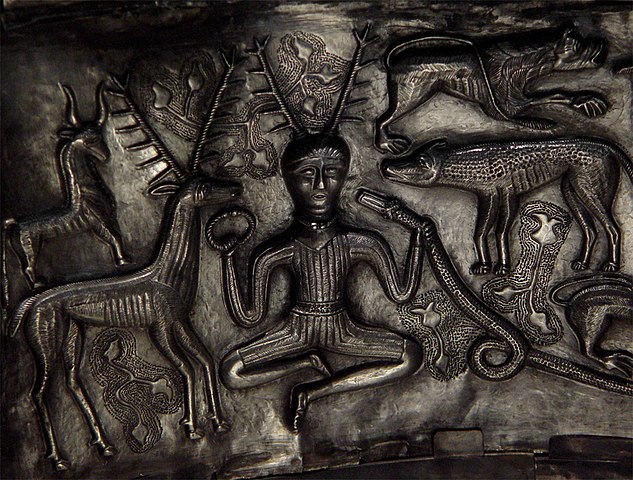
I used the question mark at the end of the subtitle because including Cernunnos as one of the figures associated with an overarching Celtic pantheon, may not be entirely correct. According to John T. Koch, in Celtic Culture, A Historical Encyclopedia , there exists only a single written reference to Cernunnos, a statuary. His name is listed (with the 'C' missing) along with other Gallic, Romano-Gallic, and Roman deities. He is depicted as having a stag's horns decorated with what look like Gallic torques. This depiction of Cernunnos is in keeping with many other carvings of a similar deity figure, the most famous of which is the seated figure on the Gundestrup cauldron (at right), found in a Danish peat bog. This image is also purported by many Celtic archeologists and ethnohistorians (e.g., Miranda Green and Arnulf Krause) to be of Cernunnos.

The figure on the cauldron sits with legs crossed - a lotus-like pose - his antlers prominent, holding a ram-headed snake in one hand and a torque in the other. Other similar images of him have been found in locations throughout the former continental Celtic provinces, leading some Celtic historians to conclude they represent the same deity. Interestingly, the Cernunnos figure is often cited as evidence that the Celts apparently did worship their gods in a semblance of human form and even suggests the idea of deities that can shape-change, alternating between human and animal.

Medieval misericord; Vendôme, France
Many people have made connections with Cernunnos and other, more modern versions of Wild Men (e.g., Herne the Hunter, The Green Man), most of which apparently have no real documentation to support any congruence, despite similarities in a few of the names. Some researchers also postulate that conflation of Cernunnos and (Greek deity) Pan by recalcitrant Pagans resulted in the Christians demonizing him, although Elaine Pagels in her excellent but dense book The Origins of Satan argues convincingly that this is not the case. 

 Whether all or any of the assumptions and claims about the importance of Cernunnos to the conglomerate of tribes that comprised the continental Celts was true will likely be forever beyond our reach. Since he was apparently never romanized (interpretatio Romana), the Roman chroniclers never paid him much heed. That doesn't stop us from wondering just who Cernunnos was and how he was worshipped among the early Celts.

And that doesn't prevent fantasists such as myself from using the figure of Cernunnos for fictional purposes. Indeed, at least from what I've gleaned from the literature, Cernunnos fulfills - with a high probability - the idea, if not the reality, of a pan-Celtic deity . He was worshipped for fertility, prosperity, hunting, and his affinity for wild animals including (most often on depictions) stags, boars, ram-headed snakes, and, less frequently, bulls. It makes sense. What's not to like?

I knew I needed to use him. How to depict Cernunnos was my first dilemma. I chose a fairly subtle combination of traits taken from many sources that hint at a tripartite nature: fertility+prosperity, cthonic tendencies - but not truly Underworld, and Oracular wisdom. But there isn't much subtle about The Horned One himself. The Cernunnos of the Schattenreich series dwells in Ande-dubnos, the Breton version of the Otherworld where he commands his hunting hounds and his loyal Folk - which I refer to as the Tud, the Breton word for people or tribe.

He rules a significant thickly forested territory therein of Brocéliande, roughly equivalent to an ancient forest (according to Jean Markale) that spread across the center of Brittany. The modern-day forest of Paimpol in Brittany is often referred to as the real-world version of the legendary Brocéliande, but its provenance is confused by the, in some cases rather tawdry, connections to Arthurian legend that date back to the middle ages.

There is magic in Brocéliande, but...

This beautifully painted wall is just wrong, wrong, wrong.


Cernunnos has the ability to shift his shape to a certain extent (for example, his horns), but his Tud followers even more so. It is questionable whether the hounds can change form or whether they are truly hounds at all. Since no actual animals populate Ande-dubnos in my version of the Otherworld, this suggests that the hounds are not really, well, hounds.

 The torque and the ram-headed snake have been incorporated into my interpretation of Cernunnos. He wears the torque, of course, but it can also be wielded as an elemental even infernal weapon, forged as it is of gold and iron. Melusine, his mate (more on Melusine in a future post), has the head of a ram, the body of a serpent - a wyrm of old - and the face of a woman. She provides Cernunnos a channel, a direct link to her domain, the Dreams, which places the God of the Hunt firmly into the Jungian realm of the deep unconscious.

This pairing is what augments his masculinity, his power - his animus - and makes The Horned One a force to be feared for an unwary wanderer, especially of the female variety, in Ande-dubnos at certain times of the year when the veil between the Otherworld and the waking world is thin. Traveler beware.


Gundestrup Cauldron by Bloodofox (Own work) [CC-BY-SA-3.0 or GFDL], via Wikimedia Commons

Green man photo http://en.wikipedia.org/wiki/File:Etching_of_Vendome_Green_Man_misericord.jpg by Simon Garbutt

Photos from Paimpol, France by Klaus-G. Hinzen

Dec 3, 2013

The Schattenreich: Cast of Characters for Book 1 and Book 2

Below is a list of major characters for the first (Primary Fault) and second  (Shaky Ground) books of the Schattenreich series. Note: these are (for the most part) NON-SPOILER descriptions. They are roughly listed in order of appearance but not of importance - now THAT would be a spoiler.

I will be adding separate character lists for the later volumes that do contain spoilers!

  • Caitlin Schwarzbach: our hero, geophysicist, data expert
  • Augustus (Gus) Schwarzbach: seismologist extraordinaire, executive director of the B.E.A.R. institute
  • Ankou, Death: Breton Celtic psychopomp. Caitlin's biggest fear
  • Dagmar Abel: beautiful, blonde, evil
  • Kilhian ar C'hoed: French businessman, interested in acquiring things
  • Antonio Delling: technician at the B.E.A.R. institute
  • Jacqueline Camp: Gus's Ph.D. student
  • Cathubodua: aka The Morrigan among other names, triple Celtic war and fertility deity
  • Cernunnos: Lord of the Hunt aka The Horned One, Celtic deity, has some nasty hell hounds, rules over a sizable portion of Ande-dubnos
  • Samantha Eschweiler: Gus's next-door neighbor, Caitlin's friend, has four kids
  • Anna Sturm: television reporter, likes Gus
  • Eduard Hall, the Burg Lahn chauffeur
  • Hagen von der Lahn: archeologist, baron of Burg Lahn, lethally handsome
  • Heinrich von der Lahn: likes leather, plays guitar, singer-songwriter
  • Erich von der Lahn: paternal uncle to Hagen and Heinrich 
  •  Richard Eschweiler: Samantha's estranged husband
  • Professor Joachim Lohmann: nemesis, professor at the Uni Cologne
  • Dr. Jürgen Vogel: nemesis, Cologne city manager
  • Susanna Wilting-Boxberg: Burg Lahn neighbor
  • Leslie James: historian, colleague of Hagen von der Lahn
  • Hauptkommissar Miriam Richter: detective, Cologne Police, murder and serious crimes
  • Hauptkommissar Horst Schmitz: detective, Cologne Police, Frau Richter's sidekick
  • Sebastian von der Lahn: gourmet cook, runs Burg Lahn
  • Bertha von der Lahn: Sebastian's half sister, actress, playwright

Nov 1, 2013

The Schattenreich: Heinrich's songs

For Kala Goañv. the Breton Celtic celebration that coincides with Halloween, this year's pumpkin and a song composed by Heinrich von der Lahn for Caitlin Schwarzbach.

The 2013 pumpkin expertly carved by Klaus-G. Hinzen


The Wolf and the Wildcat
Heinrich von der Lahn

The wolf met the wildcat there
Where twin moons rose and trees swayed bare
They found the fire that ate men's souls
Fueled by voices dark as coals
Wolf cried to Wildcat, what have you seen?

She howled and barked, what does it mean?
Wildcat tried to calm her fears
 He said, come let me dry your tears

**
Little Wolf, I love you
 Like the sun loves the dew
Like the moon loves the sea…
Do you still love me?
I promise you another forever
Just so you know
 **

Bound by blood and bound by desire
Wildcat kept Wolf safe from the fire
Apart and together, they ran and they ran
Wolf became Woman and Wildcat Man
She danced for him fast and danced for him slow
And went down a road where he could not go

She became Swan to float down Life's stream
He became Fish in the Ocean of Dreams

**
Little Wolf, I love you
Like the sun loves the dew
Like the moon loves the sea…
Do you still love me?
I promise you another forever
Just so you know
**

Fish washed up dying on the shore
Where Swan found him once more
She said, shed your scales and come with me
We'll ride the winds for eternity

Midnight black and purest white
Two swans flew together through the night
Safe at last from the ravaging fire
They sang as they circled higher and higher

**
Black Swan, yes I love you
Like the sun loves the dew
Like the moon loves the sea
Will you still have me?
I give you another forever
Just so you know