Search This Blog

Showing posts with label Celts. Show all posts

Jan 22, 2014

Mythology of the Schattenreich: Cernunnos

Pan-Celtic Lord of the Hunt(?)
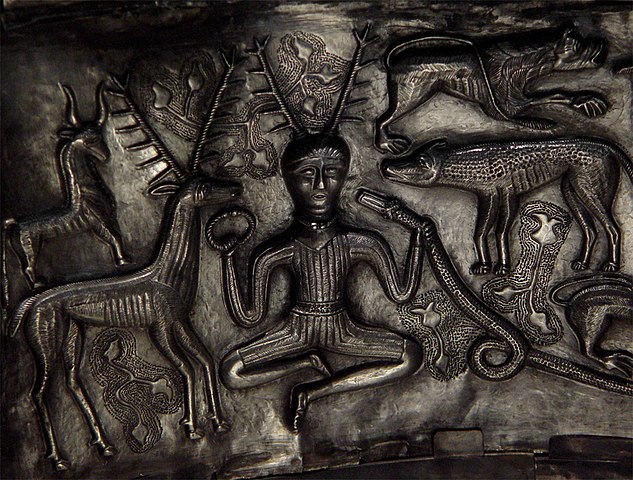
The Horned One and his bestiary
I used the question mark at the end of the subtitle because including Cernunnos as one of the figures associated with an overarching Celtic pantheon, may not be entirely correct. According to John T. Koch, in Celtic Culture, A Historical Encyclopedia , there exists only a single written reference to Cernunnos, a statuary. His name is listed (with the 'C' missing) along with other Gallic, Romano-Gallic, and Roman deities. He is depicted as having a stag's horns decorated with what look like Gallic torques. This depiction of Cernunnos is in keeping with many other carvings of a similar deity figure, the most famous of which is the seated figure on the Gundestrup cauldron (at right), found in a Danish peat bog. This image is also purported by many Celtic archeologists and ethnohistorians (e.g., Miranda Green and Arnulf Krause) to be of Cernunnos.

The figure on the cauldron sits with legs crossed - a lotus-like pose - his antlers prominent, holding a ram-headed snake in one hand and a torque in the other. Other similar images of him have been found in locations throughout the former continental Celtic provinces, leading some Celtic historians to conclude they represent the same deity. Interestingly, the Cernunnos figure is often cited as evidence that the Celts apparently did worship their gods in a semblance of human form and even suggests the idea of deities that can shape-change, alternating between human and animal.

Medieval misericord; Vendôme, France
Many people have made connections with Cernunnos and other, more modern versions of Wild Men (e.g., Herne the Hunter, The Green Man), most of which apparently have no real documentation to support any congruence, despite similarities in a few of the names. Some researchers also postulate that conflation of Cernunnos and (Greek deity) Pan by recalcitrant Pagans resulted in the Christians demonizing him, although Elaine Pagels in her excellent but dense book The Origins of Satan argues convincingly that this is not the case. 

 Whether all or any of the assumptions and claims about the importance of Cernunnos to the conglomerate of tribes that comprised the continental Celts was true will likely be forever beyond our reach. Since he was apparently never romanized (interpretatio Romana), the Roman chroniclers never paid him much heed. That doesn't stop us from wondering just who Cernunnos was and how he was worshipped among the early Celts.

And that doesn't prevent fantasists such as myself from using the figure of Cernunnos for fictional purposes. Indeed, at least from what I've gleaned from the literature, Cernunnos fulfills - with a high probability - the idea, if not the reality, of a pan-Celtic deity . He was worshipped for fertility, prosperity, hunting, and his affinity for wild animals including (most often on depictions) stags, boars, ram-headed snakes, and, less frequently, bulls. It makes sense. What's not to like?

I knew I needed to use him. How to depict Cernunnos was my first dilemma. I chose a fairly subtle combination of traits taken from many sources that hint at a tripartite nature: fertility+prosperity, cthonic tendencies - but not truly Underworld, and Oracular wisdom. But there isn't much subtle about The Horned One himself. The Cernunnos of the Schattenreich series dwells in Ande-dubnos, the Breton version of the Otherworld where he commands his hunting hounds and his loyal Folk - which I refer to as the Tud, the Breton word for people or tribe.

He rules a significant thickly forested territory therein of Brocéliande, roughly equivalent to an ancient forest (according to Jean Markale) that spread across the center of Brittany. The modern-day forest of Paimpol in Brittany is often referred to as the real-world version of the legendary Brocéliande, but its provenance is confused by the, in some cases rather tawdry, connections to Arthurian legend that date back to the middle ages.

There is magic in Brocéliande, but...

This beautifully painted wall is just wrong, wrong, wrong.


Cernunnos has the ability to shift his shape to a certain extent (for example, his horns), but his Tud followers even more so. It is questionable whether the hounds can change form or whether they are truly hounds at all. Since no actual animals populate Ande-dubnos in my version of the Otherworld, this suggests that the hounds are not really, well, hounds.

 The torque and the ram-headed snake have been incorporated into my interpretation of Cernunnos. He wears the torque, of course, but it can also be wielded as an elemental even infernal weapon, forged as it is of gold and iron. Melusine, his mate (more on Melusine in a future post), has the head of a ram, the body of a serpent - a wyrm of old - and the face of a woman. She provides Cernunnos a channel, a direct link to her domain, the Dreams, which places the God of the Hunt firmly into the Jungian realm of the deep unconscious.

This pairing is what augments his masculinity, his power - his animus - and makes The Horned One a force to be feared for an unwary wanderer, especially of the female variety, in Ande-dubnos at certain times of the year when the veil between the Otherworld and the waking world is thin. Traveler beware.


Gundestrup Cauldron by Bloodofox (Own work) [CC-BY-SA-3.0 or GFDL], via Wikimedia Commons

Green man photo http://en.wikipedia.org/wiki/File:Etching_of_Vendome_Green_Man_misericord.jpg by Simon Garbutt

Photos from Paimpol, France by Klaus-G. Hinzen

Jun 18, 2013

Women on Wednesday Interview

Reproduced below is my interview with the Pubslush blog Women on Wednesday feature. Pubslush is an interesting and potentially useful crowdfunding concept that also contributes to increasing literacy (focused on children) with giving partners (for example, Flying Kites in Kenya). They are a hybrid corporation (that is, they have both profit and non-profit status.) I am not affiliated with Pubslush and have no experience with their publishing arms and therefore cannot say anything about them, either good or bad, but they included an interview with me on their website and I'm grateful for that. My advice is, if you are interested in such a venture and want to be a part of their team, look at the terms carefully, and then ask them for more details before entering into any binding agreement - which you do even if you submit to them.

Here's the link to the interview, and again, my appreciation to Genevieve Little of Pubslush for including me.

Nov 28, 2012

The Next Big Thing


I was tagged for this post by Priya Sharma for which I'm grateful. It's a cool thing. Stop now and go immediately to Priya's site and read her interview about a story that she's very promptly sold! While waiting for her story to appear, you can read some of her other fine stories at Albedo One, Black Static (issue 28) and Interzone (current issue).

Next week, plus or minus a few time zones, Richard Jones (blogging here) speculative fiction writer and author of A Dude's Guide to Babies (pre-order now!) will be posting his answers to these questions.


1) What is the working title of your next book/short story/project?

My next published book will be Shaky Ground, due out in a few weeks. My next (still-in-my-head) book will be an alternate-historical mystery with the working title of Tainted Earth. The two don't have anything in common despite the titles and the German setting.

2) Where did the idea come from for the book?

This is a complicated and not completely linear thing, this genesis of ideas. I suspect it's probably that way with most writers. Anyway, I'll try.

Shaky Ground is the sequel to Primary Fault, the first book in my Schattenreich series. I got the idea for the first book when we first started working on the archeoseismology of the Roman ruins being excavated in the Archeological Zone in Cologne (the paper that came out of that project is open access, published by Springer Verlag and downloadable here). The events in the novel are all fictional, but the real world controversy surrounding the (still unsupported) hypothesis that an earthquake could have forced Charlemagne, Emperor of the Holy Roman Empire, to abandon his seat of government in Cologne for Aachen greatly inspired me. Even though the Schattenreich series is contemporary, I also have plans to do a few historical shorts linking the past and the present.

But what really caught my fancy was a certain Roman well – a part of the excavations in the middle of Cologne – just across from the Rathaus or City Hall, in fact. This Roman well, still in use in Charlemagne's time, kept bugging me, wouldn't let me go. Plus I had started reading heavily about Druids and continental Celts and knew that had to be a part of the story. Druids+Roman ruins+Earthquakes. It was enough to get started. Even though the Roman well doesn't come into play until Shaky Ground, it was always there, in the back of my mind while writing the first book.

So, complicated.

3) What genre does your book fall under?

Fantasy suspense with a healthy dose of romance.

4) What actors would you choose to play the part of your characters in a movie rendition?

Ha! I love this question because actually answering it will totally ruin everyone's – including my own – private images of the characters in the book. After giving it much thought, there's only two characters I'd pin down with an actor/actress: Anne Hathaway would, I think, be the perfect Caitlin Schwarzbach. Marco Girnth, a German actor who is mainly known for his work in the television police procedural SOKO Leipzig (the show is not particularly riveting, but I do enjoy watching Marco Girnth :-)) would be the perfect Heinrich von der Lahn and matches the mental picture I have of him.

I'm still trying to figure out who could play Sebastian von der Lahn. He's the most complicated character in the series, and I have to admit, I'm completely stumped. There are probably a half dozen excellent German actors who could do the role justice. Specifying an actor to play Hagen von der Lahn remains beyond my abilities at the moment. Gus Schwarzbach is such an amalgam of people I've known in my life, that it would also be impossible for me to pin him down. From looks alone, though, Garth Brooks comes pretty darn close.

5) What is the one-sentence synopsis of your book?

A tale of seismology, Druids, and an evil blonde.

6) Will your book be self-published or represented by an agency?

Self-published under my imprint, Terrae Motus Books.

7) How long did it take you to write the first draft of the manuscript?

Four months. But it's taken me over three years to get it into publishable shape. It was a complete mess. It was the second novel (after Primary Fault) that I wrote. Even though I'm an incurable Pantser, Shaky Ground was the last novel I will ever write without some sort of a Road Map. I realized after it was finished that I didn't ever want to wander in the wilderness like that again.

8) What other books would you compare this story to within your genre?

Difficult, since it's a mix of real world science and contemporary fantasy. There's Outlander, by Diana Gabaldon, but other than the Celtic cultural references and the romance aspects, the two books couldn't be more different. I would love to have it compared to Roger Zelazny's Amber series, but the comparison falls short once you get past the Otherworld/mythological aspects and the freaky Gothic castle.

9) Who or what inspired you to write this book?

That's easy. Impending unemployment (that thankfully did not transpire!) Plus encouragement from another scientist who had written a novel (and gotten it published). I thought, if he could do it…so I sat down one day and started with Chapter 1. No plan. No real clue at all. Three months later I had Primary Fault. That was a little over five years ago. And after I finished, I immediately started writing the sequel, Shaky Ground. Everyone warned me away from doing that, from continuing to write books in a series before I had sold the first one. They were completely right. But I'm incredibly stubborn. And not so smart. However, I am immensely glad I did it. It's been a liberating experience, writing the books I always wanted to read. I'm now writing the fifth and final book in the series (if I change my mind on this, please just push me off a cliff). 


Sep 6, 2012

Archeoseismic study of damage in Roman and Medieval structures in the center of Cologne, Germany

I am proud of all the authors of the above-named paper (Klaus-G. Hinzen, Stephan Schreiber, Claus Fleischer, myself, and Isabel Wiosna; see link below), the culmination of three years of research, one doctor title (Stephan Schreiber), a master's degree (Isabel Wiosna), and much groundbreaking research. The original research proposal, funded by the German Science Foundation, heavily influenced scenarios in the first two books of my fantasy series. (N.B. None of the researchers can be blamed for the parts about the Druids; I came up with that on my own, or indeed any of the facts I may have misrepresented on purpose or accidentally.)

The 3D laserscans form the meaty portion of the paper, used by Dr. Schreiber in his dissertation for documenting the damage to and creating a comprehensive virtual model (CVM) of the ruins, samples of which are shown below:


Perspective views towards the virtual model of the (town hall) apse, before and after the start of the excavations, respectively. In between d and e an orthographic view from south to the Roman well is shown.

The Roman well caught my fancy. Wells were sacred places to the Celts, and I thought it would make a great place to hide something. ('Hide what?' you ask. Stay tuned for Shaky Ground, book 2 of the Schattenreich series, due out in late Fall, 2012). Although many of the facts warped into something different in my series (as fiction is wont to do and for which I make no apologies), it was an honor to work with everyone on the project.
 
The above-named paper, out in the August 2012 issue of Journal of Seismology is an Open Access paper. The pdf can be freely downloaded or read online at this link: http://rd.springer.com/article/10.1007/s10950-012-9327-2.

Jul 10, 2012

Books and Gods


Needing to get away from the computer last week, I visited the Römisch-Germanisch Museum in Cologne to see the current exhibit, The Return of the Gods, premiering marble sculptures and ancient paintings on loan from the Pergamon Museum and the Collection of Antiquities (through end of August, 2012), featuring such reliefs as  Neptune from Greek times.
 

I then revisited the rest of the museum which contains the (in-situ) Dionysus mosaic (at right).

The museum is a must-see for all tourists visiting Cologne. That means the locals (like me) often don't go. I frequent the Praetorium often, but hadn't been to the RMG in years.


The best part was browsing the Museum Shop afterwards. It contains an impressive collection of historical books about the Greeks, the Romans, of course, and, to my surprise, some excellent books on the Celts and the Germanic tribes. I bought three, all in German (sorry for those not fluent in German).

 Die Kelten by Martin Kuckenburg (ISBN 978-3-8062-2274-6), a nearly-coffee table size book with gorgeous color pictures and adequate coverage of the Continental Celts.

Die Germanen, by Bruno Bleckmann (ISBN 978-3-40658476-3), B&W pictures and much text. I'm looking forward to dipping into this one

Auf Römerwegen durch die Eifel, Thomas Schiffer (ISBN 978-3-93972247-2), a bargain buy, contains a compilation of the traces of Roman presence from Cologne through the Eifel region of Germany. This will be useful for side trips, especially when on the way to somewhere else.

Apr 25, 2012

Are you a Celt?


According to Éloi Johanneau of the Académie celtique, established during Napoleon's rule  (John T. Koch, Celtic Culture, a Historical Encyclopedia), the answer is, unequivocally, yes. But I think we can safely assume he wasn't entirely, shall we say, objective. The answer is, if you come from Indo-European stock, probably yes.

While many, if not most, of the Christian or, at least, Catholic, holidays that are celebrated have been stolen—er—appropriated from pre-existing Celtic rituals or observances (see my column from the March-April bulletin), we also have some remnants of observed holidays and festivals that do not necessarily have a 'clear' Christian correspondence.

The celebrations that in modern times have come to be known as May Day (e.g., Beltane, in Gaelic, Kala Hañv in Breton Celtic) represents one such holiday. One of the two most important days in the Celtic year, the associated rituals are as interesting as they are (to most of us) mystifying. Much of what is celebrated today is of a more recent nature (i.e., Lady Day) than what the original Celts likely observed, which was the half of the year associated with summer.

The main ritual, started on May Day eve: Fire. Bonfires were lit as symbols of purification and perhaps to honor the Celtic god, Bel. Although not much is known about him, Bel was most certainly a solar god. According to Miranda Green (The Gods of the Celts), solar deities, probably mostly local to individual tribes but common across the Celtic world, were extremely popular. To appease the local deity, cattle were driven between double bonfires in a purification ritual. Dancing around (or over) the fires was common, and 'dancing in the May' is still celebrated in Germany today. There are also fertility rites associated with this day that could account for some of the medieval and later efforts at repression.
In Germany, May Day is a national holiday honored in political rallies across the country celebrating labor. An older tradition, as in other parts of Europe, is for a young man to fell a sapling (usually birch in Germany) and, decorated with ribbons, place it in front of his sweetheart's home. Note: in leap years (2012), this task falls to the maidens

Also in Germany, Walpurgisnacht, named for the much beloved St. Walpurga, is celebrated  both historically and  contemporary as a witches' sabbath (see, for example, Goethe's Faust), with the main festivities taking place on the Brocken (1141 m), the highest of the Harz Mountains. Closer to home, you can celebrate this event at the Witches' Market and Festival at Burg Satzvey from April 29-May 1 (www.burgsatzvey.de). You won't need your maypole, but don't forget to take your broomstick.

Mar 25, 2012

Eostra


What better way to celebrate the Pagan in you than with the Christian ceremony of Easter. A nice summary of the various religions and their associated sun worship, resurrection cults and symbols is given by http://www.guardian.co.uk/commentisfree/belief/2010/apr/03/easter-pagan-symbolism. On closer inspection, though, some connections between our current Easter traditions and a heathen one tossed around in the article, do not hold up.

Since I write fantasy that has its roots in a long-extinct culture, the continental Celts, these topics continually fascinate me. The association of Christian holidays with Pagan ones does seem to bother some people. But as one of my characters, an agnostic Druid, is fond of remarking, "there's no reason not to be inclusive."
So what about this mother goddess Eostre—or is she really Ostara—whose holiday was hijacked? According to Æ. Hunt-Anschütz from the Association of Polytheist Traditions (http://www.manygods.org.uk/), there is only one mention of her in any of the church writings during the centuries where the great Easter Controversy (see, e.g., http://en.wikipedia.org/wiki/Easter_controversy) raged about how to actually calculate the holiday cycle. 

Since the Celts were notoriously insistent on not writing anything down, damn them, we have no information about what Eostre represented or how she was worshipped. Did fluffy bunnies frolic at her feet? Or did she hand out gaily painted eggs to her followers? And what about chocolate? Did the Eostre-faithful cover themselves in the stuff to celebrate? I love this quote from  Æ. Hunt-Anschütz, "I very much doubt the heathen Anglo-Saxons honoured Eostre with eggcups. I very much doubt they had eggcups." We will never know, but re Hunt-Anschütz, the traditions of rabbits and colored eggs originated in times when the Europeans were already Christian. 

And what about the connection with Easter and Patrick, the most revered of Irish saints? We commemorate his death in a most secular way on March 17 by wearing green and rolling in four-leafed clovers. Much of St. Patrick's history is also clothed in mystery—whether he was the first Irish bishop and when he died—but he was definitely a player in the Easter Controversy, computing his own Easter cycle. He was also a fictional character in the Ulster Cycle of Irish mythology, battling a zombie Celtic hero and discoursing with supernatural Druids, literature that St. Patrick apparently also helped bring into existence (John T. Koch, in Celtic Culture, A Historical Encyclopedia).

So get out those egg cups, bite into a chocolate bunny, and light a candle for Eostre. There's no reason not to be inclusive, is there?