Search This Blog

Showing posts with label fantasy. Show all posts

Jan 22, 2014

Mythology of the Schattenreich: Cernunnos

Pan-Celtic Lord of the Hunt(?)
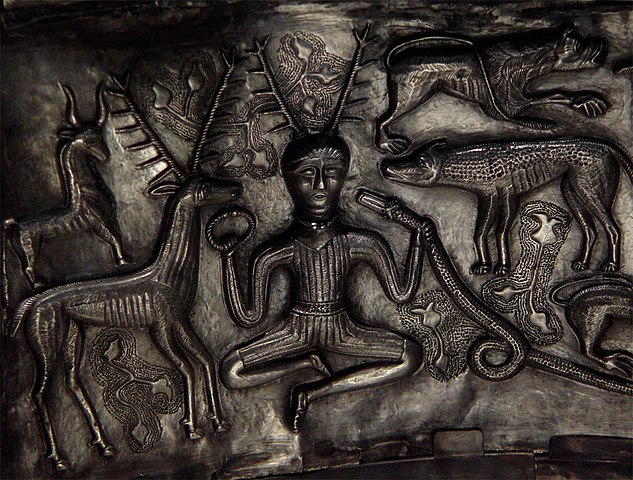
The Horned One and his bestiary
I used the question mark at the end of the subtitle because including Cernunnos as one of the figures associated with an overarching Celtic pantheon, may not be entirely correct. According to John T. Koch, in Celtic Culture, A Historical Encyclopedia , there exists only a single written reference to Cernunnos, a statuary. His name is listed (with the 'C' missing) along with other Gallic, Romano-Gallic, and Roman deities. He is depicted as having a stag's horns decorated with what look like Gallic torques. This depiction of Cernunnos is in keeping with many other carvings of a similar deity figure, the most famous of which is the seated figure on the Gundestrup cauldron (at right), found in a Danish peat bog. This image is also purported by many Celtic archeologists and ethnohistorians (e.g., Miranda Green and Arnulf Krause) to be of Cernunnos.

The figure on the cauldron sits with legs crossed - a lotus-like pose - his antlers prominent, holding a ram-headed snake in one hand and a torque in the other. Other similar images of him have been found in locations throughout the former continental Celtic provinces, leading some Celtic historians to conclude they represent the same deity. Interestingly, the Cernunnos figure is often cited as evidence that the Celts apparently did worship their gods in a semblance of human form and even suggests the idea of deities that can shape-change, alternating between human and animal.

Medieval misericord; Vendôme, France
Many people have made connections with Cernunnos and other, more modern versions of Wild Men (e.g., Herne the Hunter, The Green Man), most of which apparently have no real documentation to support any congruence, despite similarities in a few of the names. Some researchers also postulate that conflation of Cernunnos and (Greek deity) Pan by recalcitrant Pagans resulted in the Christians demonizing him, although Elaine Pagels in her excellent but dense book The Origins of Satan argues convincingly that this is not the case. 

 Whether all or any of the assumptions and claims about the importance of Cernunnos to the conglomerate of tribes that comprised the continental Celts was true will likely be forever beyond our reach. Since he was apparently never romanized (interpretatio Romana), the Roman chroniclers never paid him much heed. That doesn't stop us from wondering just who Cernunnos was and how he was worshipped among the early Celts.

And that doesn't prevent fantasists such as myself from using the figure of Cernunnos for fictional purposes. Indeed, at least from what I've gleaned from the literature, Cernunnos fulfills - with a high probability - the idea, if not the reality, of a pan-Celtic deity . He was worshipped for fertility, prosperity, hunting, and his affinity for wild animals including (most often on depictions) stags, boars, ram-headed snakes, and, less frequently, bulls. It makes sense. What's not to like?

I knew I needed to use him. How to depict Cernunnos was my first dilemma. I chose a fairly subtle combination of traits taken from many sources that hint at a tripartite nature: fertility+prosperity, cthonic tendencies - but not truly Underworld, and Oracular wisdom. But there isn't much subtle about The Horned One himself. The Cernunnos of the Schattenreich series dwells in Ande-dubnos, the Breton version of the Otherworld where he commands his hunting hounds and his loyal Folk - which I refer to as the Tud, the Breton word for people or tribe.

He rules a significant thickly forested territory therein of Brocéliande, roughly equivalent to an ancient forest (according to Jean Markale) that spread across the center of Brittany. The modern-day forest of Paimpol in Brittany is often referred to as the real-world version of the legendary Brocéliande, but its provenance is confused by the, in some cases rather tawdry, connections to Arthurian legend that date back to the middle ages.

There is magic in Brocéliande, but...

This beautifully painted wall is just wrong, wrong, wrong.


Cernunnos has the ability to shift his shape to a certain extent (for example, his horns), but his Tud followers even more so. It is questionable whether the hounds can change form or whether they are truly hounds at all. Since no actual animals populate Ande-dubnos in my version of the Otherworld, this suggests that the hounds are not really, well, hounds.

 The torque and the ram-headed snake have been incorporated into my interpretation of Cernunnos. He wears the torque, of course, but it can also be wielded as an elemental even infernal weapon, forged as it is of gold and iron. Melusine, his mate (more on Melusine in a future post), has the head of a ram, the body of a serpent - a wyrm of old - and the face of a woman. She provides Cernunnos a channel, a direct link to her domain, the Dreams, which places the God of the Hunt firmly into the Jungian realm of the deep unconscious.

This pairing is what augments his masculinity, his power - his animus - and makes The Horned One a force to be feared for an unwary wanderer, especially of the female variety, in Ande-dubnos at certain times of the year when the veil between the Otherworld and the waking world is thin. Traveler beware.


Gundestrup Cauldron by Bloodofox (Own work) [CC-BY-SA-3.0 or GFDL], via Wikimedia Commons

Green man photo http://en.wikipedia.org/wiki/File:Etching_of_Vendome_Green_Man_misericord.jpg by Simon Garbutt

Photos from Paimpol, France by Klaus-G. Hinzen

Dec 22, 2013

Review of The Iron Wolves, by Andy Remic

Book 1 of the Rage of Kings

The Iron Wolves
Andy Remic
IBSN 978-0857663566
Angry Robot
Release Date: December 31, 2013

From the book’s description:

Thirty years ago, the Iron Wolves held back mud-orc hordes at the Pass of Splintered Bones, and led a brutal charge that saw the sorcerer Morkagoth slain.

Now, a new terror stalks the realm. Orlana the Changer has escaped from the Chaos Halls and is building an army, twisting horses, lions and bears into terrible, bloody hunters, summoning mud-orcs from the slime and heading north to battle the mighty region of Vagandrak where, it said, the King has gone insane.

General Dalgoran searches to reunite the heroes of old for what he believes will be their final battle. But Dalgoran discovers the Iron Wolves are no longer the heroes of legend, and they might just be more dangerous than the invading hordes.

My insanely short synopsis: The Iron Wolves, a band of seven unlikely and (somewhat) unsavory heroes punch, kick, bite and slash their way across the kingdom to reach Vagrandak, the land of legend and the Iron Wolves’ past glory. Their goal: to do battle against the great Sorceress Orlana to stop her from enslaving and slaughtering the entire population of the realm.

On his seventieth birthday, General Dalgoran witnesses a scene so gruesome, it forces him to end his retirement and reassemble the Iron Wolves, his band of seven warriors, now past the prime of their hero years. But General Dalgoran believes they are the only ones capable of combatting the horror he has witnessed. But first he must find them all and convince them of his cause.

The Iron Wolves seethes with action; indeed, it stomps across every page.

Remic has a very precise way with descriptions of battles and fights and with weapons of every type (including head butts). The scenes leap and snort off the page, making the heart race with anticipation about their outcomes. The journey of the Iron Wolves entails many such battles including those against insanely powerful creatures called the splice – amalgams of human and beasts that are very tough to kill – and mud orcs as well as more human enemies. Including the Iron Wolves themselves.

If you enjoy sword and sorcery, The Iron Wolves will not disappoint. The heroes themselves, although not necessary likeable, present a convincing case for their role as the only ones capable of confronting the powerful and merciless Orlana. I felt there was adequate backstory from each of the seven warriors to comprehend something of their motivations; these stories do not necessarily make the characters more likeable. But it did help me to understand them.

Orlana, not born of this world, has an agenda. I didn’t understand what that agenda was in any great detail, this is Book 1 after all, but I learned enough to know that her plans entail much more than crafting nasty and menacing creatures. Her very evilness contrasts starkly with the dubious nature of the Iron Wolves’ heroism. I never had any doubts about who I was rooting for.

On the other hand, although the story has its straightforward components, there are plenty of subplots and interesting complications to occupy the mind while reading. Even though the it is the nature of epic fantasy with good versus evil made me want to think that good will triumph, I never felt sure about the outcome at any point in the story.

And that is what kept me reading. Sometimes, the fights went on too long for my liking so that I had to put the book down for a while, but I think for those who read graphic and gritty sword and sorcery with gusto, and who enjoyed The Clockwork Vampire Chronicle series by Remic, this will be a positive feature. For me, it’s guilty candy. Something I don’t read often because, while I enjoy it in small doses, most of the time slash and gore are not done well. But here it is done well and is dictated by the nature of the story.

On a less positive note, there’s a reader cheat in here. It marred the story for me somewhat, and I can’t talk about because it would be a spoiler. In all fairness, we do get hints about it, but not enough that I felt I could have figured it out on my own. That said though, I could live with that and hope the rest of the series will live up to the promise of the first book, an uncompromising but ultimately entertaining romp through a fantasy landscape pockmarked with treachery around every corner.